Maybe you’ve been there…
You’ve had two weeks lounging by the pool and the beach. You’ve enjoyed the slow pace of island life, of the cool breeze in the day, the idyllic scenery at every turn. And yet, the minute you board the plane to head back to real life you realize: you’re still just as tired as you were when you left.
You certainly rested. But you’re plagued by the question why you’re not restored.
Is something wrong with me?
Am I not cut out for this job?
What kind of life do I really want, anyway?
The plane eventually lands on the runway but the unanswered questions remain up in the air. You consign yourself not to seek out the answers because the deadlines are rapidly seeking you, along with all of the unread notifications, messages, and emails that have piled up in the two weeks since you left.
Welcome back.
Why do I feel this way?
More than mere exhaustion, burnout is fundamentally a loss of identity. Slowly, gradually, or even all at once we lose ourselves to the work that we once found fulfilling. Who we are apart from our jobs, our roles, or the results of our lives begin to fade from view. You begin to see yourself primarily (or exclusively) through the work that you do whether in your workplace or your family. The perceptions of others have slowly become more important to you than your own self-regard and personal integrity (more on this later). The small decisions that you made over the course of your whole career or family life have now metastasized into a set of handcuffs that you handcrafted for yourself.
And though you built the cuffs, you don’t hold the key. Everyone else does.
What happens when we burn out is that we lose touch with who we are apart from work or the roles we play in life. It’s not just that you sacrificed the hobbies, interests, relationships, or passions which once fulfilled you – you sacrificed yourself. Whether it was out of obligation, duty, or a divine calling that got misappropriated, you made the decision that who God made you to be was not as important as the expectations of others.
At first, this decision felt noble, heroic – worth it. Perhaps you genuinely believed in the work, the cause, the worthiness of the goal. Your boss’s praise, your team’s appreciation, or your family’s satisfaction gave you added proof that it had been the right decision to make. Their approval, which had once been a secondary bonus for the sense of fulfillment and accomplishment you gained from working, slowly slid into becoming the primary metric of your worth, value, identity. If they weren’t pleased, if they complained, if the outcome was not to your liking – it would mean the end of the value you offered!
This is when the chains clicked into place.
Your schedule began to run you.
Your job began to work you.
Life, in its urgent tyranny, was making all the important decisions for you.
But who could you blame? At a subconscious level, you recognize that you were complicit at every step of the journey downward. That you, as much as anyone, are responsible for the state of your soul and your life. And yet, having lost the capacity to look inward, you can’t name the shame you carry. And so, silently and with not a small measure of guilt, you trudge on in life fulfilling everyone else’s dreams and never your own.
Download my free 72-Hour Burnout Recovery Guide -- a practical faith-based resource to help you begin recovering what burnout took from you. It's free, and it's where we start the journey back.
Rest alone cannot restore that sacrifice.
Yet, we imagine that we only need to rest long enough and that our real selves will begin to rise back to the surface. So we scrounge for enough PTO to sit long enough on the beach or the couch in the vain hope that we’ll magically come alive again. Meanwhile, though we’re “doing nothing” we’re more often than not doing something on our phones.
Among many things, the smartphone has deluded us into thinking that if we’re sitting on the couch, the beach, or by the pool that we can afford to distract our minds by indulging in social media, short-form videos, games or the like and call it rest. In our weariness, we give ourselves to these indulgences for hours on end, unaware that in such a state we simply cannot be trusted with something like our phones. Research consistently links heavy social media use to increased anxiety, reduced attention, and disrupted sleep. Beyond this, it’s also self-evident that by flooding our systems with a steady stream of dopamine driven distractions we only compound the damage that is being done to both our body and soul.
Ironically, however, the way we use our phones today is completely revealing for what our souls are truly longing for in burnout: agency.
When we have so shackled ourselves to others’ demands, perceptions, opinions, and timetables – in addition to the natural exhaustion that comes by working hard – we long for a freedom that no longer seems real. And so we opt for digital freedom. This is at the root of all forms of virtual escapism, whether in social media, binge watching shows, video games, and the like. And all the while we continue sacrificing our human potential to these hollow substitutes we tragically remain trapped in the Chinese finger trap that is working badly and resting poorly. In a critical way, the last thing burned out people need is to do nothing. Rather, they must do what is restorative to their true, God-given self.
The Crack at the Bottom
The prophet Jeremiah ministered in a particularly desperate time in Israel’s history. Witnessing the collapse of the kingdom of Judah, he witnessed firsthand how the people had consistently refused to heed the warning of the prophets who had preceded him. In a poignant passage, he gives us an invaluable addition to the solution to burnout.
In Jeremiah 2:13 he writes,
“My people have committed two sins: They have forsaken me, the spring of living water, and have dug their own cisterns, broken cisterns that cannot hold water.”
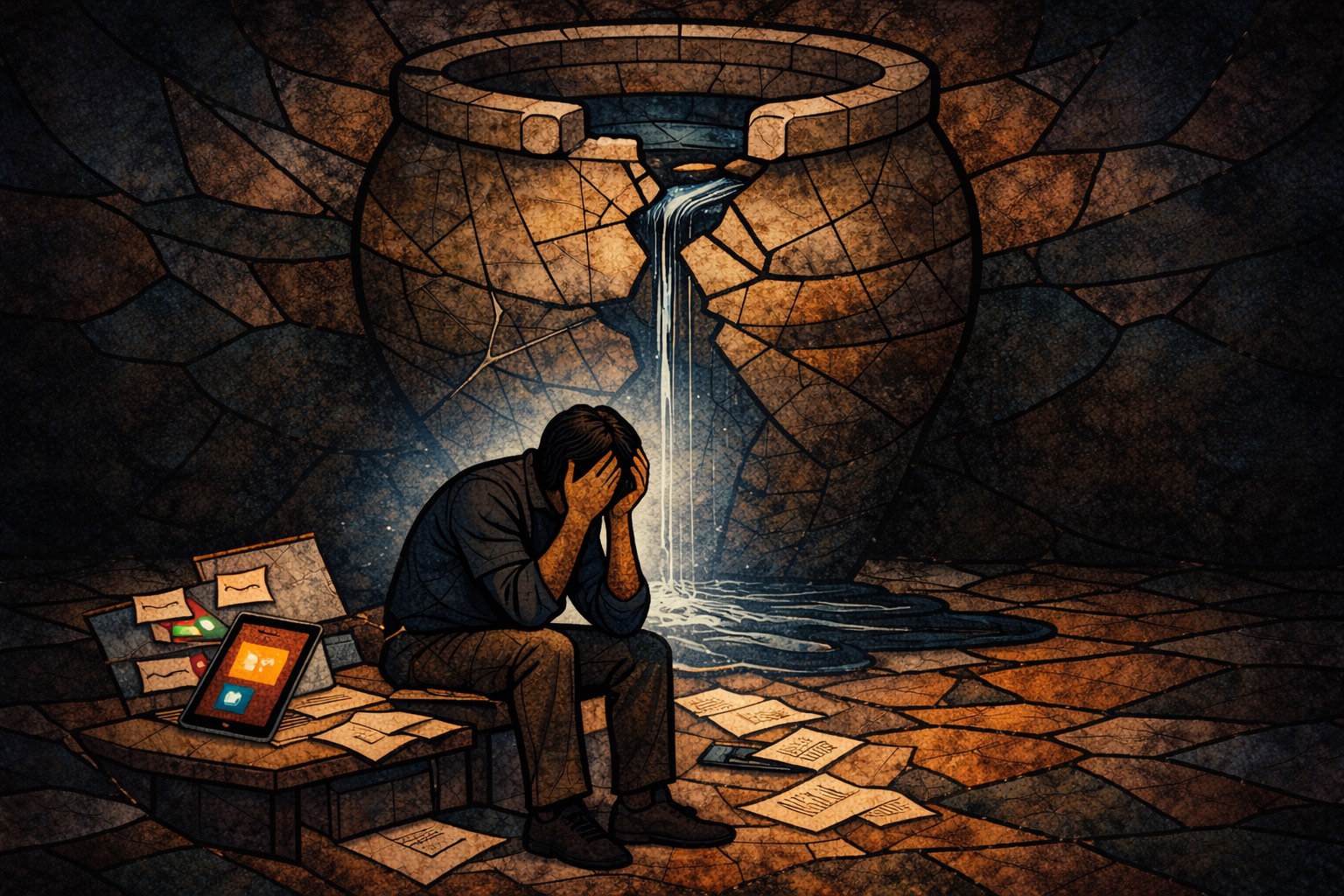
Jeremiah accurately prescribes the state of people who have lost their way: though they are filling their cups with everything they can, the central problem remains that there is a crack at the bottom. No matter how much water, wine, alcohol, or otherwise is poured into the cup, it will come right out of the bottom. This is ultimately why rest alone is insufficient to restore a burned out person. Their identity has been cracked, compromised at the bottom, and it must be sealed once again by a greater bond.
This was the great tragedy of the idolatry that Israel indulged in: they had abandoned their God-given identity and preferred ones that could not hold water. Like the good-intended people who have been deluded or deceived into sacrificing themselves for a circumstantial identity on works, performance, or expectations the Israelites would never have enough water to account for the hole at the bottom.
Jeremiah follows up this insight with a rhetorical question in v. 14,
“Is Israel a servant, a slave by birth?
Why then has he become plunder?”
The biblical reader would know that the answer to Jeremiah’s question is no. God had declared that “Israel is my firstborn son” (Exodus 4:22) and that they were chosen to be a “kingdom of priests” (Exodus 19:6). But this identity had been forfeited by their own behavior. The people of Israel were living like slaves.
The conclusion that follows is profound: whenever we abandon our God-given identities, slavery is the inevitable, unsurprising, tragic result.
You will always be thirsty when you abandon this God-given identity. You will always be dry. You will always be tired because you are incapable of storing any of the good things that are being poured into the gaping maw of your bleeding heart. No amount of numbing, of coping, of anything at all will restore your burned out husk if you do not surrender the cup itself to the God who is meant to hold it.
It is only a God-centered identity, resting completely and regularly on the finished work of the great Liberator, Justifier, Sanctifier, Glorifier, that a person is able to seal the crack at the bottom of the soul.
Sealed Up in Something Greater
Knowing the crack that exists in every human heart, God declares through his prophet in Jeremiah 31:33,
“This is the covenant I will make with the people of Israel
after that time,” declares the LORD.
“I will put my law in their minds
and write it on their hearts.
I will be their God,
and they will be my people.”
The antidote for a broken heart is a covenant that seals it up. God’s greater faithfulness to Israel, to all of us, is to fulfill what we cannot and so cover our identity in His promises. When we yield to this, God makes it plain that it reorients our entire selves: “I will be their God, and they will be my people.” Our identities become less about what we do on our own, and instead centering on what He has done (and continues to do) for us. This allows him to write his character on our minds and on our hearts, such that we need no external compulsion to follow his ways.
For all those who are in Christ, the promises of God and full reconciliation are applied fully and totally to our account. This means that:
When others are displeased with you, He “delights in you.” (Zephaniah 3:17)
While we fall short, His grace “abounds more.” (Romans 5:20)
Though we wander and stray, He “joyfully puts [us] on his shoulders and goes home.” (Luke 15:5-6)
“If we are faithless, he remains faithful, for he cannot disown himself.” (2 Timothy 2:13)
It is the identity of burned out people that must be restored to them, and it is their identity of which they must be reminded. The only One who can remind and restore children is their Father. And it is only in His presence, He who created rest, that this can be offered: “anyone who enters God’s rest also rests from their works, just as God did from his” (Hebrews 4:9).
This isn’t abstract theology. For the burned out person it has a shape and a practice.
#1 Time Spent in Nature/Outside
True rest is woven into the fabric of creation. It was only after the seventh day of resting that God’s act of creation was fully completed (Genesis 2:2) and it was only after Adam’s first full day of existence, spent in rest with God, that he was even able to begin his duties as the garden’s steward. Rest was something God Himself voluntarily, joyfully engaged in, as “he saw all that he had made, and it was very good” (Genesis 1:31) and basked in the goodness of it all. Time outside, in nature, is intrinsic to rest. Beginning our days with even a fifteen to thirty minute walk around the neighborhood, the park, the hiking trail, the biking route does tremendous good that has been documented by science and experienced firsthand by everyday people. This can be as frequent as a daily practice and certainly no less than a weekly one.
#2 Creative expression, fulfilling work, and reasserting yourself
As burned out people, enslaved to the work we have done for others, it is vital we experience agency again. In order to do this, we must gently but intently coax our God-honoring desires to the surface, and allow the expectations of others to drift away. A simple practice could be lying in bed (without any distractions) until the natural need to rise, live, and engage with the world causes you to start your day. (This pairs well with the kind of walk we described above – all taking place before you pick up your phone). Additionally, we foster agency by practicing, creating, or doing work by which we are fulfilled and energized. Just as God found joy in creating, we find joy in recreating and in recreation (Genesis 1:31-2:3). This can look like artistic expression, athletic expression, or any form of work that is done for nobody else but you. This elevates hobbies to be an expression of ourselves, and an act of shared joy with God.
#3 Mutuality and fellowship
While our relationships to our families or our colleagues can be part of the trap we have fallen into, relationships of mutuality and genuine fellowship are a central component of recovering from burnout. This is because it saves us from constantly performing for others. Ironically, these are the kinds of relationships that are the first to get sacrificed when we’ve chosen slavery to others’ expectations of us. If we cannot impress the people who are mutually sharing life’s burdens and joys with us we instinctively eliminate them. But we must be intent to “carry each other’s burdens, and in this way you fulfill the law of Christ” (Galatians 6:2). This mutuality is nonnegotiable in the Christian life – and it is the only way to protect oneself from constant performative living. We observe that Jesus himself, while needing nothing from his disciples, nonetheless prioritized time with his disciples “come away with me” (Mark 6:31). Time prioritizing relationships of mutuality is not a selfish desire, it is a discipleship imperative.
#4 Begin setting boundaries for yourself
This is the follow through that requires tangible trust. As a result, it is a scary process. Ultimately we must be willing to set boundaries in order to make our lives reflect the reality to which God is increasingly syncing us. For the Jews, this meant an observance of the Sabbath (Ezekiel 22:8). For the believer, it means abiding in the Sabbath-rest of Jesus (Hebrews 4:9-11). Though this is a spiritual realization for the believer, it must remain a tangible one. Resting from our own works as God does from his remains an imperative that, while not salvific, is no less normative. Have the hard conversations with your boss or your spouse that must be had. Setting limits is not a failure of faith – it’s evidence that your identity is no longer for sale.
#5 Prayerful meditation on Scripture
The greatest need is time spent in prayerful meditation in Scripture. This is both a challenge of will and dedication for tired, burned out people, but it is also a challenge for those who have a tendency to misappropriate God’s presence as a checkbox rather than a privilege. When we pray we are entering God’s restful, gracious, glorious throne room (Hebrews 4:16) where “pleasures forevermore” abound (Psalm 16:11) and where the Spirit of God is able to mediate “every spiritual blessing” (Ephesians 1:3) that has been given to us in Christ. The difference this makes cannot be overstated. It is the practice that truly differentiates Christian spirituality from the mere therapeutic culture that has so dominated our spirituality. It is also this practice that remains woefully neglected in our understanding of rest. Rather than it being something to do, it is something by which we’re reminded of what God, and only God, has done. It is the most fundamental way that we continue “remaining” (John 15:4) in the finished work of Jesus and not our own.
If this resonated with you, the best next step is downloading my free 72-Hour Burnout Recovery Guide – a practical faith-based resource to help you begin recovering what burnout took from you. It’s free, and it’s where we start the journey back.
If you’d like to keep going beyond 72 hours, my 40-day devotional Rekindled: A 40-Day Devotional for Burned Out Christians is available on Amazon and guides you through the Scriptures I found to be the most impactful for me as I recovered from my own burnout.
[Get Rekindled on Amazon →]